俄狄浦斯王-讲演记录
演讲稿
// PPT 第一页
Thank you so much and good morning everyone. Today our group is gonna to talk about the king Oedipus. The plan for us will be devided into several sections. You can see that on the screen.
// PPT 目录页
The first section will be a background introduction. And this part is carried out by me using a top-down approach.
The second part will be a play cast by the whole team.
The third,fourth,fifth sections will be carried out by other students in our team. They will give you a more detailed explanations on each part of this article in different dimensions of view.
And the final section will be a summary and conclusion.
Please be noted that because we have different perspectives, so every student will give out one question, one for each, according to his typical topic.
// 打开xmind。收紧状态
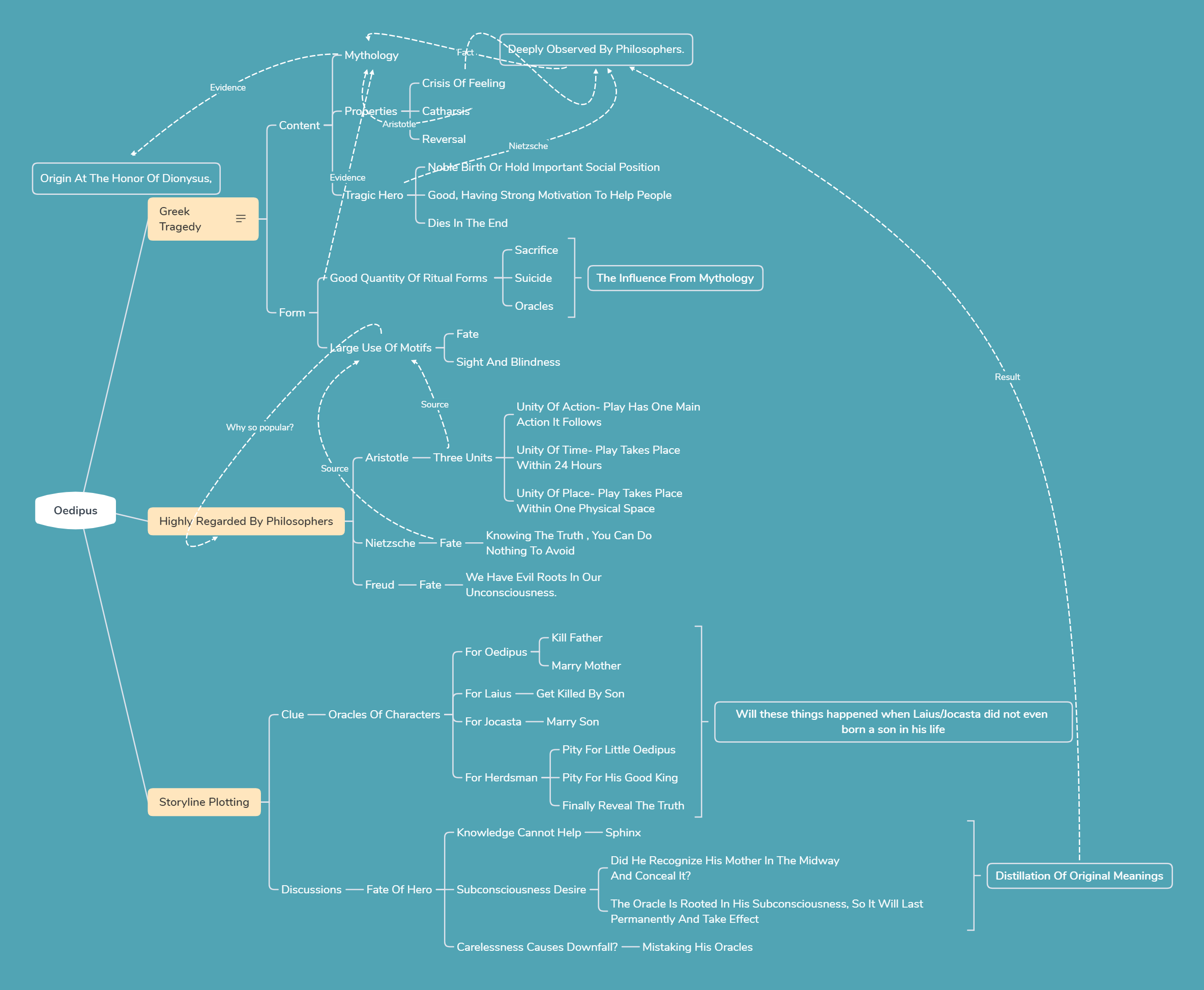
So here is my part. As you can see, I try a new illuration to reconstruct my thoughts and ideas. The reason I do not use ppt is that I want to show the correlation between some concepts to illurate some ideas, which is very hard to do without a mindmap. I am sorry for the inconvincence, and I will greatly appreciate for your comprehensions.
// 展开Tragedy那块,只展开到Mythology
The first part is the Greek Tragedy. It is quite different from a typical film or play you watch nowadays. So you may want to know the details of the distinction. So let’s move on. Here, we go to the content section to see those details. And we come to know that Mythology is largely consisted in the content of a greek tragedy. But you do not stop here. You need to think twice, why could the mythology get involved? Then you see this line on the left, and you can know that the origin of greek tragedy is Dionysus, which is a greek god, a strong symbol of mythology. And that can explain why mythology can get invloved. Look, you can easily get some directed ideas from this chart, so that I can save my words and focus more on more important things. So after this example, I think you can all get some directed ideas from the training. So now I will go straight towards those more important ideas.
// 完全展开Tragedy那块
Still in first part, we can have a general idea that the greek tragedy is mainly associated with two things, the one is mythology, and the other one is philosophers. Good. We can easily see that the Properties part is associated by philosophers, which is Catharsis given from Aristotle. The same way with Tragic hero Part given by Nietzsche. Thus we can conclude this part, that the greek tragedy is getting some influenced by the mythology, and giving some influence to the philosophers! The greek tragedy itself serves as a bridge from the traditional objects and the future concepts!
// 展开Highly那块
So now we move on to the second part. Still we see this in a general way, this part shows that the play Oedipus is highly regarded by philosophers, which strengthens the idea we set before, that The greek tragedy can act as a bridge. We can know that three philosophers did some research at this play and get their own conclusions. We notice that the topics of these three people point to the point called “motifs”. If you have not seen this, I will tell you that motif is like a theme that frequently occurred in plays and article works. Then you get to know that philosophers are working on different aspects of views from these motifs. And these strikes out some brand new questions, how many kinds of motifs, or say, themes are there in this play? What are they? Why are they worthy to observe and discover? Why are they so popular? Actually this is none other than the target of this part, that triggers you by the questions you raise by yourself.
// 展开第三块,clue的部分
The questions we raise just now push us to the third part, the Storyline Plotting. Unfortunately, you can only get some of these answers from it. First we look into the clue. The clue of this targedy is none other than the whole set of oracles given to each character. And from these oracles we can find out two things, one is that the oracles are always landing on a relationship between two people, and cannot be escaped no mather how much you cope with it. That’s good, but you need dive further into it. I think this question is of more insights, “Will these things happened when Laius/Jocasta did not even born a son in his life?” Food for thought!
// 展开Discussions的那部分
Still in the third part, we move on to the discussions of those philosophers about one typical motif, which is a genera1 topic, The Fate of Hero. Can he do something to avoid his fate? If so, how to do it? From the article itself we can see the first idea, knowlege cannot get in help when getting cursed by fate. The king himself had a good supply of knowlege, and with this knowlege he defeated the sphinx. But with this knowlege, he could not defeat and modify his own fate! The second one is from Freud, which inicates his Subconsciousness Desire rooted deep under his mind. The things that if you could not get rid of these desires rooted in your mind, you will be cursed forever because that you must have a small amount of crimes. But the third one is what I liked most and most curious about, which is from Nietzsche, that we know Oedipus had been misreading the fact that his father was not his biological father, so, according to this situdation, can we say that his downfall is due to carelessness(that failed to find out his identity) or silliness?
I think I can stop here, and, I will post a link here to show my ideas in a more intuitive way. You can see on the chatbox.
And Thank you so much, now let’s move on to the play today.